DIY Wedding Invitations: Stunning Designs You Can Make Yourself
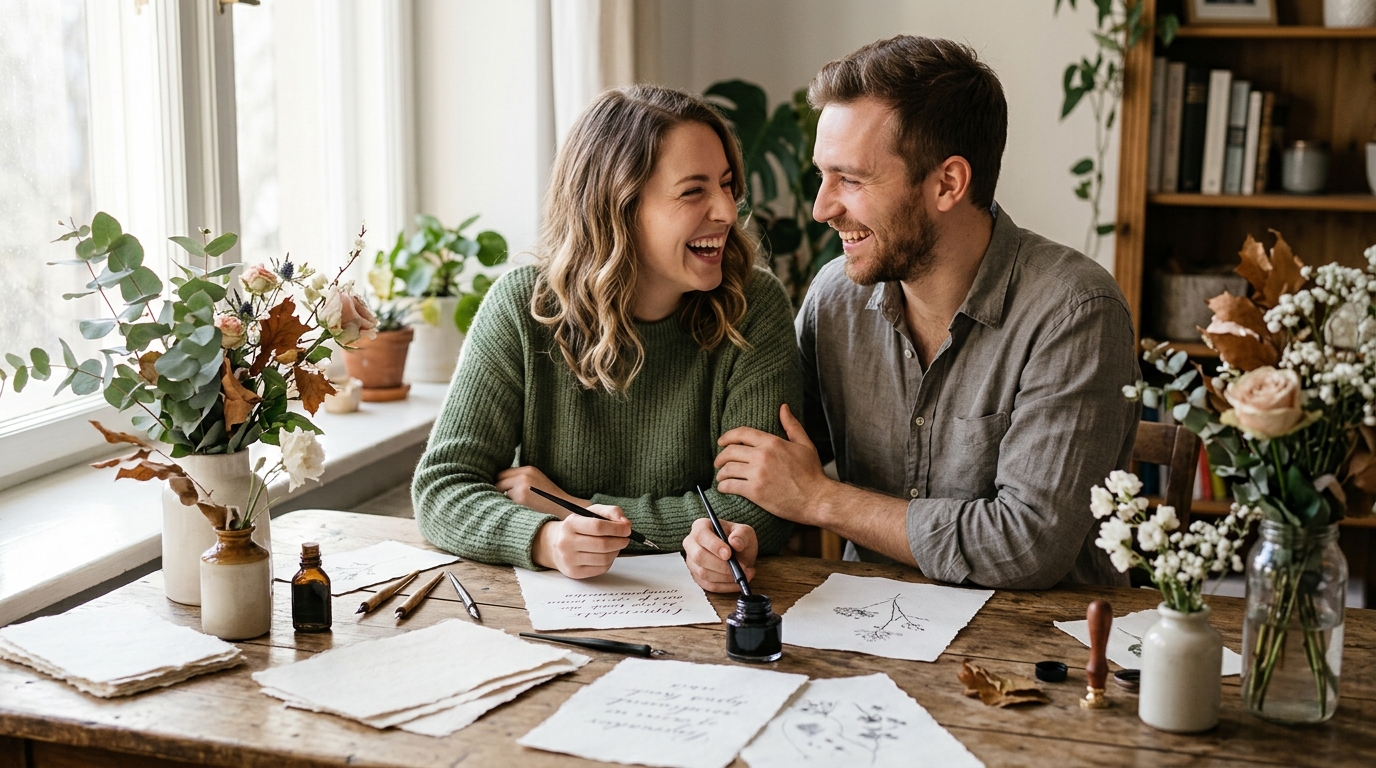
DIY wedding invitations: what you're actually signing up for
Before you buy a single sheet of cardstock, let's get honest about what making your own wedding invitations involves. Most couples discover it's less "lazy Sunday craft session" and more "three weekends of glue dots and mild existential despair." That doesn't mean you shouldn't do it. It means you should know the terrain.
The payoff is real. You save $200 to $600 compared to custom stationery suites. You get invitations that smell faintly of your favorite candle and carry the slight imperfection that makes people hold them a beat longer. And there's something deeply satisfying about addressing an envelope to your 83-year-old grandmother in your own handwriting.
But you will hit a wall around hour four. The paper cutter will drift off-square. You'll question every font choice you've ever made. This is normal. The trick isn't avoiding frustration — it's choosing a design that remains beautiful even when executed by someone running on cold coffee and deadline stress.
The $23 kit trick no one tells you about
Walk into any craft store and you'll see individual sheets of "wedding" cardstock selling for $1.99 each. Walk two aisles over to the general cardstock section. Same weight. Same cotton content. Often the exact same manufacturer. Pack of 50 for $7.
This pattern repeats across nearly every material: vellum, envelopes, wax seals, ribbon. The wedding markup is real and it is steep. A standard 5x7 invitation suite — outer envelope, invitation, details card, RSVP card, RSVP envelope — costs around $80 in materials for 75 units if you shop the wedding aisle. That same cart in the general papercraft section? About $35.
What's worth splurging on: the outer envelope. Cheap envelopes feel cheap, and they're the first thing guests touch. A 100% cotton envelope in ecru or pearl white adds softness that telegraphs quality before anyone unfolds anything. Budget about $0.40 per envelope for the good stuff. Cut corners on the RSVP envelope instead — it gets mailed back and discarded.
A counter-intuitive find: digital printing at your local copy shop often looks sharper than at-home inkjet, and the toner sits on top of textured paper instead of bleeding into it. For linen or felt-finish cardstock, always choose laser printing over inkjet. You'll get crisp lettering instead of fuzzy edges that make the text look like it's sweating.
Three invitation styles ranked by weekend tolerance
Not all DIY invitations demand the same sacrifice. Pick your style based on how much of your Saturday you're willing to trade.
One-weekend design: Flush-mount photo cards. Print a 5x7 photo directly onto heavy matte paper, mount it to a slightly larger cardstock backing with double-sided tape, and slide it into an envelope. The photo becomes the invitation face. Add text overlays in Canva before printing — date, venue, and "dinner and dancing to follow" in a clean serif. Total active crafting time for 80 invitations: about five hours.
Two-weekend design: Vellum wrap with wax seal. Print your invitation text on a simple cardstock base. Wrap a sheet of translucent vellum around the front, secure it with a wax seal at the center top, and tuck everything into an envelope. The vellum softens the text underneath and the seal provides that tactile moment when guests open it. Melting wax takes practice. Budget one evening for learning the pour technique and another full day for production. Expect some swearing during the first dozen seals. By seal thirty, you'll have it down.
Three-weekend design: Pocket fold with layered inserts. This is the ambitious choice. A folded cardstock pocket holds separate cards for the invitation, details, map, and RSVP, all wrapped with a belly band. You'll cut, score, fold, and assemble. A typical July dining table scenario: you, your partner, a drying rack of freshly glued pockets, and a Netflix show you've stopped watching because this requires actual focus. The result looks like a $12-per-suite custom job. It also consumes roughly 16 hours. Order extra cardstock — pocket folds have a steep failure curve.
Quick takeaways
- DIY invitations typically cost $35-$80 in materials for 75 suites, compared to $250-$600+ for custom stationery
- Laser printing produces sharper text on textured paper; inkjet often bleeds on linen, cotton, or felt-finish cardstock
- Full suite assembly takes 5-16 hours depending on design complexity — factor envelope addressing separately
- Budget at least 2-3 weeks before mail date; last-minute rush jobs show in crooked cuts and skipped quality checks
Materials that make cheap look intentional
There's a fine line between handmade and homemade. The difference usually comes down to three things: paper weight, edge quality, and texture contrast.
Paper weight matters more than you think. Anything under 80 lb cover stock bends when guests pick it up. It feels flimsy, like a save-the-date for a dentist appointment. Go 110 lb minimum for the main invitation card. For pocket folds or backing cards, 80 lb is fine since they're structural, not handled directly.
Edges are where most DIY invitations announce their origins. A craft knife and a straight edge leave slightly raised, slightly fuzzy cuts on thick paper. A rotary trimmer handles this better, but even then, you'll notice the difference between a clean cut and the factory edge of pre-cut paper. One elegant workaround: embrace the deckle edge. Buy paper with a natural, feathered edge and design around it. The rough edge reads as intentional, even artisanal, and it completely eliminates your cutting step.
Texture contrast creates luxury on a budget. Pair something smooth (matte photo paper, vellum) with something nubby (linen cardstock, handmade cotton paper). Add one metallic element in a small dose — a gold binder clip holding inserts together, a copper brad, a thin foil-stamped monogram sticker. Restraint here is everything. One metallic touch reads as curated. Two reads as craft store clearance aisle.
For the printing itself, most couples land on Canva or a basic Adobe Express template. These tools handle the spacing and alignment that trip people up in Word. Set your margins at 0.25 inches minimum and never stretch a low-resolution photo to fill the frame. Pixelated floral backgrounds scream "printed at home" in a way no amount of vellum can fix.
The friction point nobody plans for
You've spent weeks on these invitations. The paper is thick, the vellum is soft, the wax seals are centered. You mail them. Then something unexpected happens: guests start responding with questions that aren't on your RSVP card. "Where should we park?" "Is there a shuttle?" "What time does the bar open?"
Paper is static. Once those envelopes are sealed, you can't add information. A details card covers the basics — hotel block, ceremony time, dress code — but it can't handle late-breaking updates or the mild chaos of last-minute weather changes.
This is the exact point where a Video Guestbook adds a layer of flexibility your paper suite can't. The same QR code you print on an insert card or mention on your details sheet gives guests access to updated information, day-of logistics, and a place to record video messages that you'll actually keep. Traditional photo booths produce strips that curl up in drawers; paper guest books sit on shelves unopened for a decade. A video guest book captures voices, laughter, and the uncle who had one too many and delivered the most heartfelt three-minute speech of the entire evening. Worth thinking about as you're designing that insert card.
Addressing envelopes without losing your mind
Addressing 80 envelopes by hand takes roughly four hours. Your hand will cramp. Around envelope forty, your handwriting will degrade into something that looks like a ransom note. This is fine.
A few things help: practice on scrap envelopes first, especially the recipient's name, which you'll write larger and with more care than the address. Use a template behind the envelope to keep lines straight — print address lines on a sheet of cardstock, slide it inside, and the show-through guides your pen. And choose an envelope color that forgives mistakes. Bright white shows every wobble. Cream or pale gray hides them.
If your handwriting is genuinely illegible, hire a local calligrapher for addresses only, not the full invitation. Guest addressing typically costs $2-$4 per envelope and spares you the humiliation of your cousin receiving an invitation addressed to an unintelligible squiggle.
Factor envelope addressing time into your production schedule. Addressing is the most neglected line item in DIY invitation planning, and it's the one that causes the most midnight panic when the mail deadline is 36 hours away and you're still licking the tenth envelope.
The beauty of the slightly imperfect
Store-bought invitations are flawless in a way that's also forgettable. The kerning is perfect. The paper is uniform. They look like every other invitation suite printed on the same machine the week before.
Yours will have a soft bend in one corner where you pressed the wax seal a beat too long. One envelope will have a stamp placed a millimeter crooked. You'll notice these things because you made them. Your guests will not. They'll notice the weight of the paper. The way the vellum slips off. The small, dried flower you pressed into the twine. They'll notice that someone cared enough to make something by hand for an occasion that only happens once.
And when they arrive at your wedding, that QR code on the table will be waiting to capture what paper never could: the sound of their laughter, the warmth in their voices, the exact words they chose to mark this one particular day.
Make Your Wedding Unforgettable
Let your guests leave heartfelt video messages that you'll treasure forever. Our video guest book captures the love, laughter, and emotions of your special day.
Buy on Amazon — $79You Might Also Enjoy
DIY Wedding Decorations That Look Expensive But Aren't
Planning a wedding on a budget doesn't mean sacrificing style. With creativity and effort, you can create stunning …
Destination Wedding on a Budget: It's More Possible Than You Think
A destination wedding can cost far less than a traditional hometown bash if you sidestep the hidden budget traps. Smart …
Wedding Playlist 2026: Songs for Every Moment
A modern wedding playlist blends instrumentals, throwbacks, and new indie tracks into a smooth emotional arc. Learn whic…